I’ve been using the Eisenhower Matrix in Todoist to categorize my tasks:
p1 means it’s an important and urgent task; I probably don’t get any long-term fulfillment from this kind of task, but it has to be done soon.
p2 roughly corresponds to "decide" but is important, but not necessarily urgent. I don’t look at p2 tasks daily. These are long-term things to work on that have impact.
p3 tags are things I might be able to delegate to someone else or possibly take care of quickly, urgent but not important on the matrix.
This post on Twitter showed a novel rethinking of the Matrix’s quadrants. The key difference here is the language used for the four quadrants; I don’t remember seeing them put this way before: Do (p1), Decide (p2), and Delegate (p3). You don’t need to put "Deletes" in Todoist.
You find yourself in need of a second spritz, but dispirited by a lack of prosecco, having finished your stash with someone special. The obvious answers–beer? White Claw?–prove unsatisfying. You lapse into a moment of despair, but alight from this fog inspired: what if you subbed out the prosecco with some Chardonnay?
You extract yourself from the pool and trundle to the kitchen. Plenty of Aperol. Plenty of seltzer. Oranges, too. You pour some of the white stuff into a shaker filled with ice. Pour in the correct proportion of Aperol, 3:2 if you’re doing it right. You shake the mix up like Tom Cruise in a bad movie, strain into a glass with ice, and top up with seltzer and orange for garnish.
You pad back out to the pool, deliver the drink, and pretend you didn’t taste it and already declare it a worthy backup (but not a replacement for the real thing).
Zwilling Double-Walled Wine Glasses: The challenge, if you will, of enjoying a cocktail by the pool (often, in our case, an Aperol Spritz), is enjoying the drink cold while it’s nearly 100 degrees outside. These glasses keep the drink reasonably cold in comparison to your standard wine glass.
Stoicism: You may have described someone as “stoic” when you meant alexithymic. But Stoicism, as a philosophical movement, is less about adopting an uncaring attitude than it is an unflappability when faced with things you cannot control. And plenty more. Memento mori.
Snapdragon-Powered CoPilot PCs: If you prefer Windows to macOS or are at least curious, but have found the Intel and AMD chips wanting in comparison to Apple Silicon, these things are the real deal. Fast, quiet, and well-specced, Copilot PCs have renewed the competitive landscape in the Mac vs Windows debate.
Yesterday I took the boys to the Father’s Day Toy Show in Mullica Hill, NJ. It’s a nice switch from the usual shows we’ve gone to, as it’s outside. Sure, it was a little hot in the sun, but almost all of the vendors are in shaded pavillions.
Toy Show Chips Copter
This show is one of many put on my ToyShows.org. I got to wondering about the first show I ever took them to, and it only took me a few moments in Photos on my iPhone to find out: It was in Mount Laurel, NJ, on January 11th, 2011. That particular show really stands out in my mind for a few reasons. I’m sure part of the reason was that it was also my first show; I’d never been to anything like that. I remember being utterly awed at the volume of tables out with stuff on display, and the amount of stuff on display. We walked all around one large room in a hotel conference space, only to realize there was another large room full of tables. It was really big, at least as I recall it.
Team America Dirt Bike
Subsequent shows were never quite as large as that one, at least in my mind, although there were plenty of good ones. They seem to have settled, for the most part, at the Nur Shrine Center in New Castle, Delaware. These shows have a fair bit of the things the boys like to collect (fairly modern, highly articulated action figures from a variety of manufacturers), but skew now towards antiques and other items. This makes them somewhat less likely to result in big "scores," but that does happen.
Laser Tag
Increasingly, the boys really like NJ Collectors Con, which is always in Cherry Hill, always very good, albeit pricey to get into. Another favorite is the toy show that FarPoint Toys hosts on Memorial Day weekend, called "It’s a Toy Show," after their original retail location in Richland, NJ, which was called "It’s a Toy Store!" This was one of their favorite haunts (and mine) for a long time until the boys had generally found most of the older toys they might want, and it became easier to find new toys on Amazon and other online retailers.
Amarena Cherries: We’ve tried Luxardo, Starlino, and now Amarena. They are the least good, but plenty good, for cocktails and desserts. The juice is thinner than the other cherries, and they have more of a confection taste than a plummy, jammy taste.
Toy Shows: I’ve been taking the boys to toy shows operated by Richard D’Amico for years now. They are a menagerie of current collectibles (think Marvel, DC, GI Joe, and Transformers), but lots of other kitschy items that you might see for the first time, or recall from your childhood. I’d never buy the vintage stuff, but I do like taking pictures of it.
Hanger Steak: We used to be able to get hanger steak at our local butcher easily, but the supply has dried up. I like it so much that I made a website about how to prepare it. My dad got six steaks from Pat LaFrieda for fathers day and I cooked them via sous vide for four hours at 130 degrees before grilling them off. They were great.
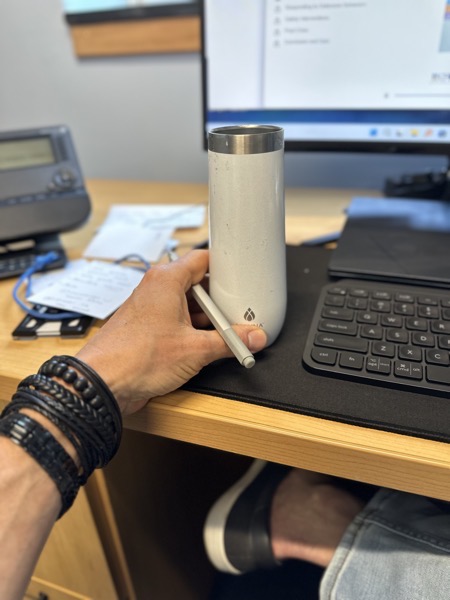
A cup of coffee, American style, is about 250 grams of brew. That’s a regular mug of coffee. Much bigger than that, you’re not gonna finish or it’s gonna get cold. That’s about 8 ounces, or…a cup.
Travel mugs, for some reason, run larger: 12 oz, 16, more even. I’ve been taking coffee to work in a too-large travel mug forever. My most recent attempt at a reasonably sized mug was the Yeti Rambler, which has a modest volume, but is too wide to fit in my Mustang’s cup holder.
I happened to see this 9 oz mug at Marshall’s yesterday at check-out, and despite the shape and sparkles, I couldn’t help but buy it. it’s the perfect size for a normal cup of coffee.
I was at our weekly guitar lesson last Thursday and working on this song while my son tuned up, and our teacher perked up, hearing the riff. He pulled together a quick tab and we ran through the song a couple of times. I listened to the song a bit more closely in the intervening days and got hooked on the lyrics. They are a good example of limerence at its finest:
Getting hard to sleep, blood is in my dreams
Love is killing me, tryin’ to figure it out
Nothing better to do when I’m stuck on you
I’m still in here tryin’ to figure it out